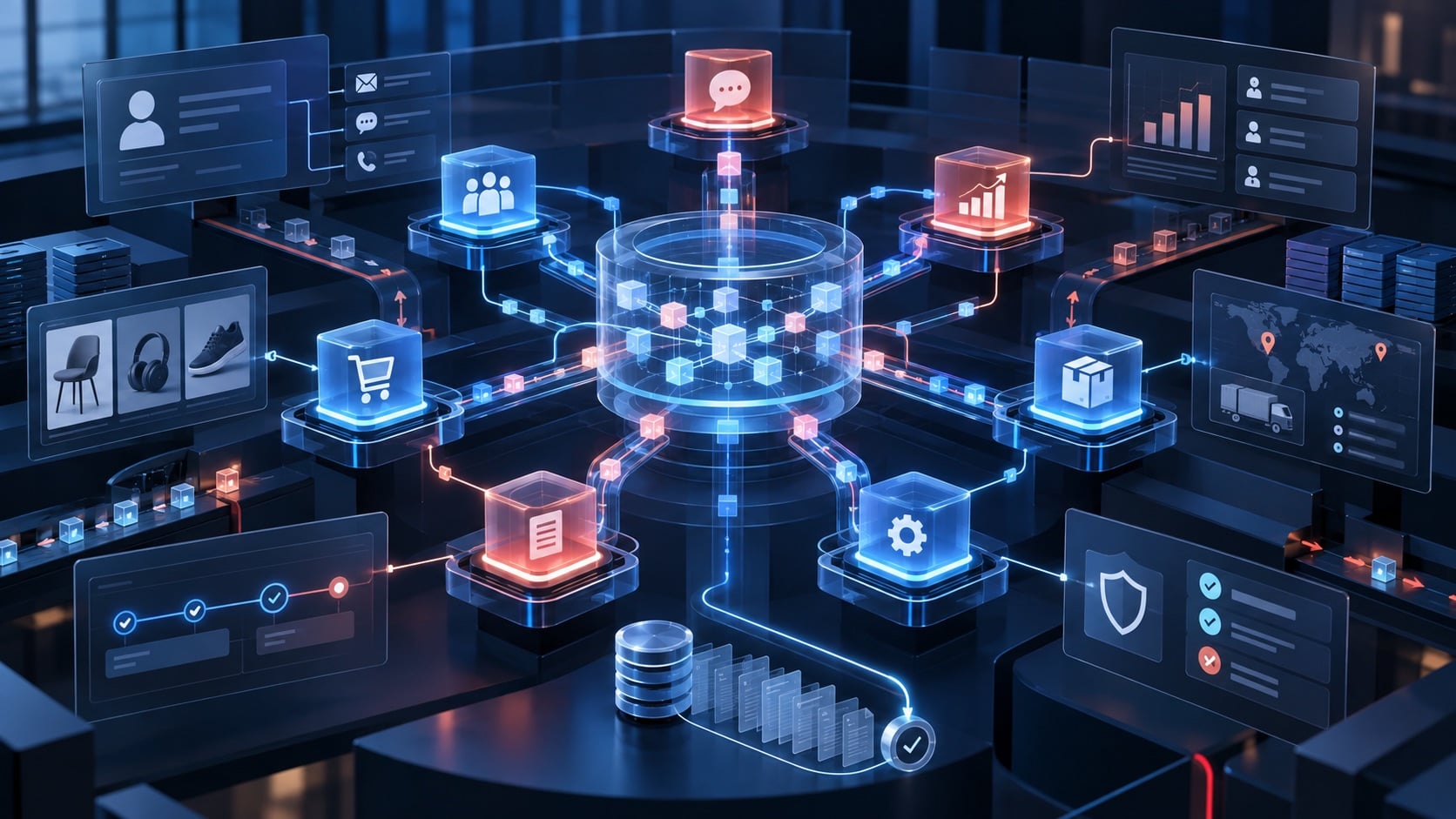
On September 11, 2026, Beijing time, Salesforce released seven Agentforce pre-configured agents for specific positions, and simultaneously introduced long-cycle runtime, skills teaching, multi-agent orchestration and optimization tools. Among the seven products, Casey, Paige, Carter, Marshall, Piper and Fin have been listed as officially available by the company, while the outbound sales agent Hunter is still being piloted and is scheduled to be officially launched in November. This batch of products is oriented to sales, service, commerce, employee experience and back-end business. The release content includes both current capabilities and future arrangements. The entire set of functions cannot be summarized as being fully online.
Intelligent agents cover customer service and employee support
This set of agents covers customer service, employee support, e-commerce, sales, supply chain and customer experience. Casey handles FAQs, returns, account management, and transfers across voice, SMS, WhatsApp, and web chat; Paige handles IT and HR requests for Slack, portals, and the tools employees use every day; and Carter handles product discovery, comparisons, Q&A, and in-chat checkout. Companies can adapt the products to fit their business processes or rename them, Salesforce said.
The remaining four products handle outbound sales, supply chain, inbound leads, and customer experience respectively. Hunter extends from researching customers to reaching out over weeks or months; Marshall orchestrates back-end supply chain processes and keeps audit records of actions; Piper is involved in lead interaction, qualification and conversion on the website and inbox; Fin handles the cross-channel customer experience process. Officials have connected them with Customer 360 customer data and business processes, but have not released a region-by-region list of availability, nor have they listed functional differences across regions.
Design details for long-term operation
Salesforce splits the long-term runtime into three parts: memory, persistent execution, and dynamic guidance. Memory is used to save context and progress across sessions; persistent execution allows plans to continue running for a longer period of time and resume or adjust after interruption; dynamic guidance changes subsequent behavior based on user feedback. Hunter is the first product to feature this runtime. The announcement describes the design approach but does not provide independent reliability evaluation, mission failure rate, recovery success rate, average mission duration or latency data.
The company uses a sales scenario to illustrate long-term tasks: Salespeople can ask Hunter to handle risky transactions before the end of the quarter, and the system establishes measurable goals, develops plans, and determines the required tools, business information, and behavioral constraints. As the mission progresses, Hunter can absorb new information and revise the plan; rules distinguish between actions that can be performed autonomously and steps that require sales approval. This example is from a product announcement and should not be assumed to be the same for all customer configurations, permission boundaries, or approval processes.
Introduction to the functions of Agent Script and AI Skills
In addition to preconfigured products, Salesforce introduces Agent Script. The company calls it an open source agent behavior language, used to combine model reasoning with deterministic rules to more finely define decisions and actions; the announcement does not list the version number, license text, or long-term support period on the same page. AI Skills allow an employee to demonstrate a task once and then scale that practice to more employees and interfaces. This feature is currently a pilot and is planned to be officially available in October 2026. The pilot qualifications and number of participants were not stated in the announcement.
Multi-Agent Orchestration, used to distribute work across roles, systems, or business phases to multiple specialized agents, has been made generally available by Salesforce. Agent Optimizer participates in the construction and adjustment of agents, sub-agents and actions, and finds areas for improvement through testing and session trace analysis; the company plans to officially launch it in October. Different components adopt different release rhythms. Buyers cannot judge what capabilities the current account already has based on the combination name alone. The official has not listed a unified account opening table.
Customer Cases and Unit of Measurement Description
Salesforce said Agentforce and Slack combined have delivered 7 billion Agentic Work Units over the past two years, including 3.2 billion in the second quarter. The announcement did not explain whether the measurement unit is equivalent to an independently completed business task, nor did it provide complete measurement rules, corresponding revenue or third-party audits. The company lists additional customer stories: 50% of Engine's chat inquiries were fully resolved by its customer service agent, 60% of Perk's sales pipeline was built by Hunter, and 70% of Autism Queensland's administrative requests were resolved by Paige.
The same announcement said Hibbett's artificial intelligence system handles 90% of the core shopping process and went live within six weeks; Asana's website agent Piper brought in four times the number of conversations before, and the average deployment time for Piper customers was 45 days. These cases are not accompanied by sample sizes, base periods or independent audits and cannot be extrapolated to typical results for all clients. Pricing and packaging details are also yet to be announced. The follow-up time points that can be checked are the October release of AI Skills and Agent Optimizer, and the November release of Hunter, and whether price, region, service level and operational reliability information will be supplemented by then.